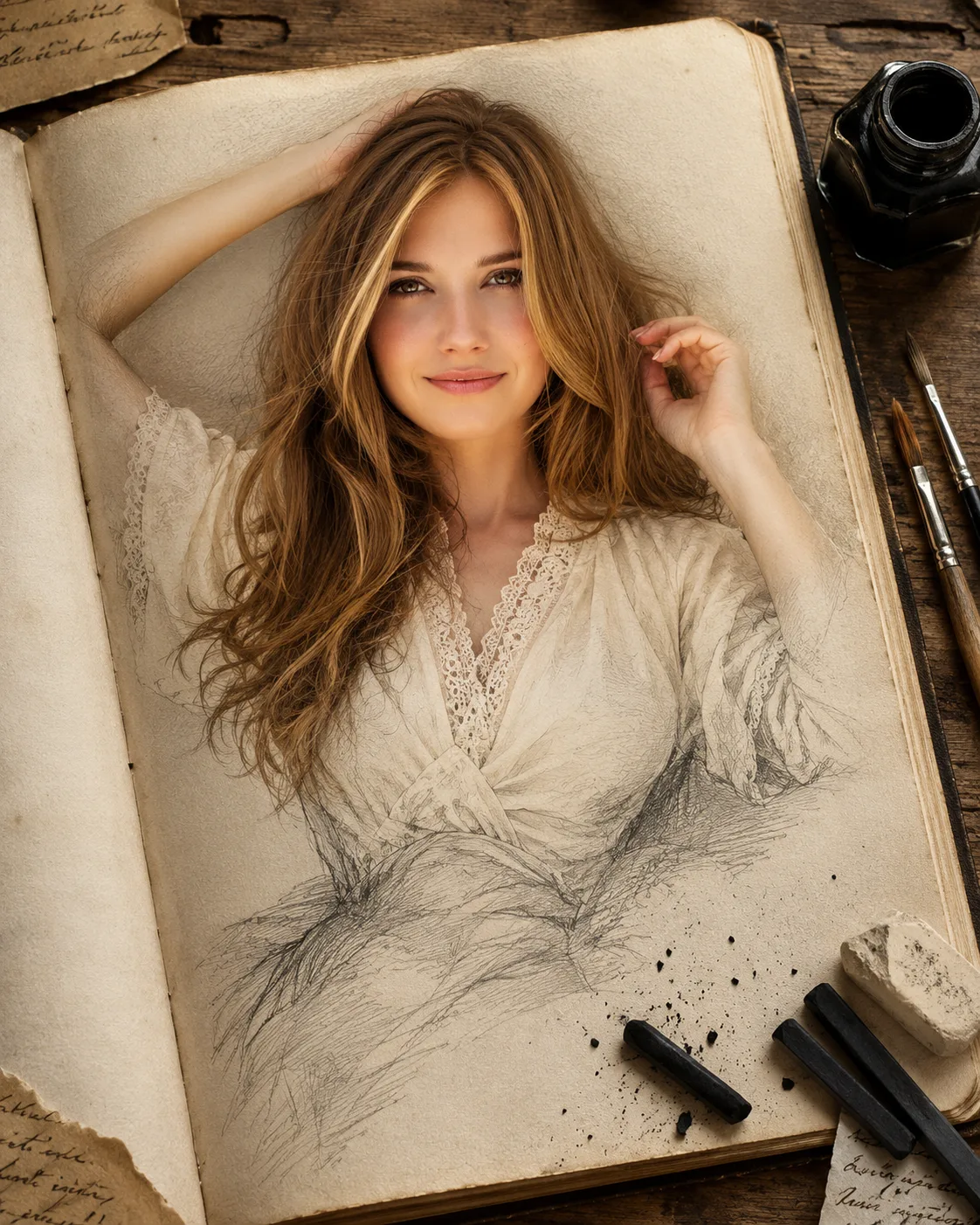
Vintage Artist Sketchbook Portrait Effect
Turn your photo into a vintage sketchbook portrait where a photorealistic figure rises from pencil artwork on an artist’s desk.
Using the uploaded photo, create a photorealistic vertical 4:5 conceptual portrait of the same person emerging from [an open vintage artist’s sketchbook] on [an antique wooden desk]. KEEP — Preserve the exact facial identity and visible structure from the uploaded photo: forehead shape, eyebrow placement and shape, eye shape and natural eye colour, nose bridge and tip, lips, cheeks, cheekbones, jawline, chin, ears, facial width, natural asymmetry, original skin tone, pores, fine texture, natural marks, and authentic age. Keep the original hairline, hair density, texture, colour, and visible hairstyle. Keep facial hair exactly as shown if present. Preserve the person’s natural body proportions, shoulder width, neck length, hand structure, finger proportions, and overall recognizable anatomy. CHANGE — Place the person inside [a large open vintage sketchbook], wearing [an ivory cotton blouse with subtle antique lace detailing]. Keep the upper body fully photorealistic while the lower body gradually dissolves into fine graphite pencil illustration. Use [cream textured paper], delicate charcoal shading, fine cross-hatching, torn paper edges, and faint handwritten artist annotations. Surround the sketchbook with [charcoal sticks], [a worn white eraser], [an open dark glass ink bottle], [two paintbrushes], graphite dust, and small torn paper scraps. SCENE — The sketchbook lies flat on [an antique medium-brown wooden artist’s desk] during late afternoon. The person appears to rise naturally from the illustrated page, with the realistic torso crossing the boundary between photography and drawing. Keep the desk softly visible around the paper, with shallow background blur rather than a completely flat backdrop. LIGHT — Use soft warm window light entering from the upper-left at roughly 45 degrees, producing gentle shadows across the face, lace, paper fibers, and desk. Keep the face illuminated from the same direction as the surrounding objects so the person does not look pasted onto the page. CAMERA — Capture the scene from directly overhead using a 50mm lens at f/4, with the camera parallel to the desk surface. Keep facial features sharp while allowing the outer desk edges and scattered art materials to fall slightly softer. GRADE — Use muted beige, warm brown, ivory, charcoal grey, and restrained sepia tones, with moderate contrast, subtle paper warmth, fine film grain, and a quiet vintage editorial print finish. OUTPUT — Vertical 4:5 aspect ratio, 2160 × 2700 pixels, highly detailed, realistic skin and fabric texture, physically believable paper depth and shadows. DO-NOT — No face slimming, no skin whitening, no changed eye colour, no plastic smoothing, no altered facial proportions, no generic model face, no invented jewellery or tattoos, no extra fingers, and no fully illustrated face.
Photo Guide
- Use a sharp photo where the full forehead, jawline, and hairline are visible.
- A front-facing or slight three-quarter angle blends best with the sketchbook layout.
- Use even daylight so pores and natural skin texture remain visible.
- Keep hairline and facial edges unobstructed for accurate identity matching.
- The warm paper-to-pencil transition is the key detail of this look.
- Heavy beauty filters can make the graphite transition look artificial.
How to Build
- 1ChatGPT: choose image generation and upload a clear reference photo.
- 2Paste the full prompt and keep the output ratio at 4:5.
- 3Use a high-resolution source with the face occupying enough of the frame.
- 4Keep image edits focused on wardrobe, desk, paper, and illustration effects.
- 5Check that the face stays photographic while the lower body becomes graphite.
- 6If wrong, regenerate with stronger KEEP identity and softer pencil transition.
Pro Tips
- Keep the face larger in the source photo so small features stay stable.
- Use a real wood-toned background reference so desk shadows blend naturally.
- Choose simple clothing in the source so the ivory blouse reads clearly.
- Avoid harsh side light because it can create mismatched facial shadows.
- Keep the graphite transition below the chest so the face remains realistic.
Share This Prompt
About the Author
Naziya
Creative AI writer at MFDA, sharing trendy photo-editing prompts and fresh ideas for beautiful, stylish AI images.