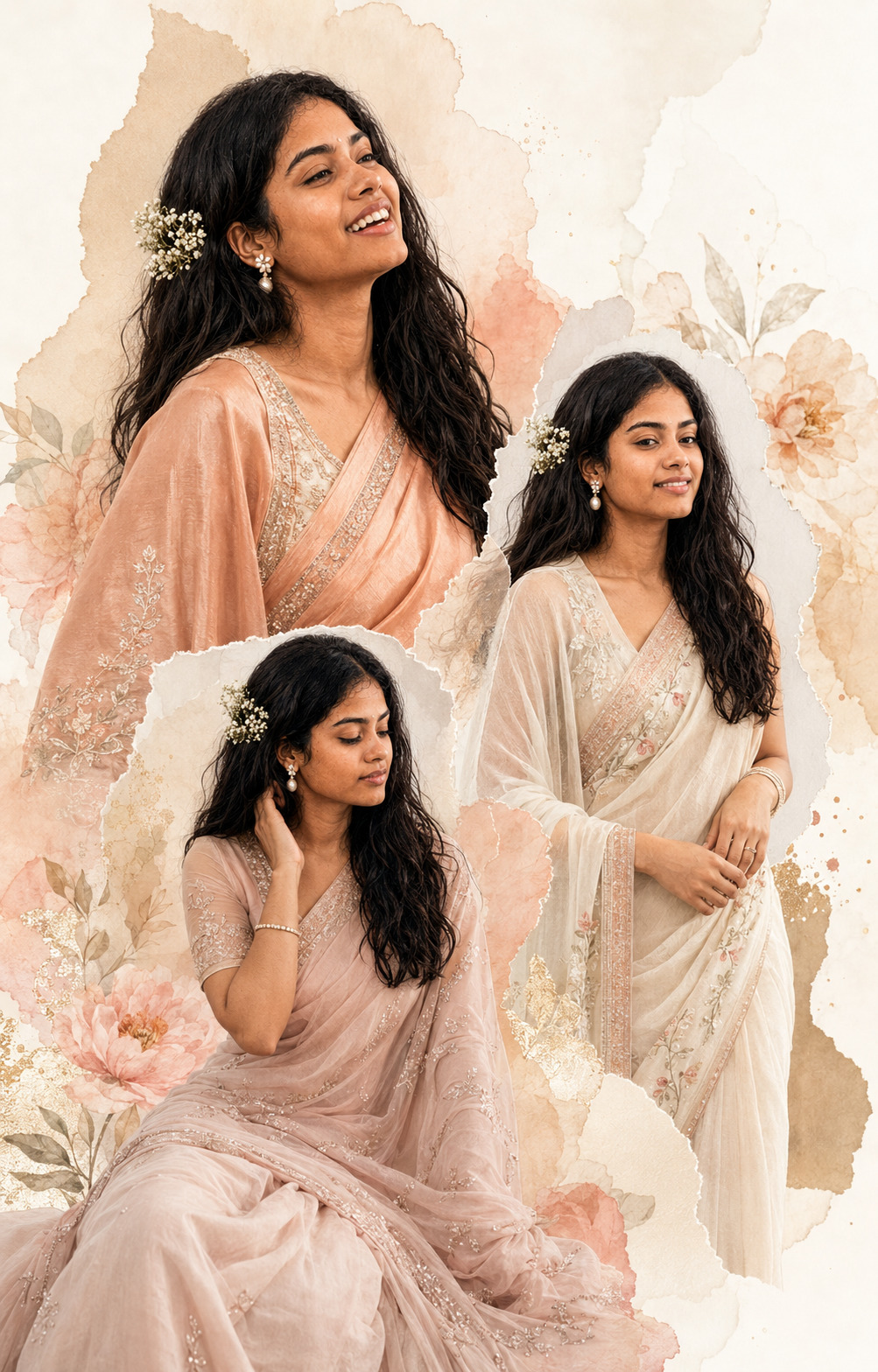
Saree Collage Portrait Prompt
Create a luxury watercolor collage portrait that preserves your real face across three saree poses on an ivory editorial background.
Using the uploaded photo, create a photorealistic luxury fashion collage of the same South Asian woman on a clean ivory-white background, combining three distinct portrait poses with soft watercolor masking and refined editorial layering. KEEP — For ChatGPT image generation, preserve the original facial landmarks and bone structure exactly. Keep the exact face shape, jawline, cheek structure, nose, lips, ears, eyebrows, eye shape and eye colour, skin tone, visible pores and natural skin texture, hairline, natural hair density, facial hair if present, and body proportions from the uploaded photo. Preserve the person's recognizable identity, natural asymmetry, apparent age, and authentic facial expression characteristics. Do not reinterpret the face as a similar-looking model. CHANGE — Change the wardrobe to three luxurious Indian saree looks using peach silk, ivory organza, and muted blush chiffon, each with delicate embroidery and realistic woven texture. Add restrained pearl earrings, slim bangles, and small floral hair accents. Create three poses: one joyful upward-looking laugh, one relaxed standing smile, and one graceful seated pose. Replace the original environment with an ivory studio backdrop featuring watercolor washes, torn-paper layering, translucent floral shapes, and soft painted edges. Use an elegant cream, peach, champagne, and blush palette. SCENE — Build the collage as a premium Indian fashion campaign on an airy ivory background. Arrange the three portraits at different depths, allowing watercolor edges to overlap naturally while keeping each face fully readable. Leave controlled negative space around the subjects and keep decorative elements softly blurred or painted rather than photorealistic. LIGHT — Use a large diffused softbox 45 degrees camera-left and slightly above eye level at approximately 5200K. Add gentle reflector fill from camera-right and a weak warm rear light for separation. Keep shadows soft beneath the chin and along the far cheek. CAMERA — Simulate an 85mm full-frame portrait lens at f/1.8, 1/200 sec, ISO 100, camera positioned around chest height for standing poses and slightly above eye level for the seated pose. GRADE — Use creamy ivory whites, muted peach, champagne highlights, soft blush accents, gentle contrast, lifted shadows, natural skin tones, and subtle fine grain. OUTPUT — Render a vertical 4:5 composition at 8K resolution with realistic fabric detail, natural pores, accurate anatomy, and clean collage masking. DO-NOT — No face slimming, no skin whitening, no changed eye colour, no plastic smoothing, no invented jewellery or tattoos, no facial replacement, no altered body proportions, no duplicated limbs, no distorted hands, and no cartoon or CGI appearance.
Photo Guide
- Use a sharp 4K+ photo with the face fully visible and evenly exposed.
- Daylight portraits blend better with the ivory studio background and pastel grade.
- Keep both eyes, hairline, jawline, and natural skin texture clearly visible.
- Choose a source showing shoulders so the saree proportions stay believable.
- Avoid beauty filters because they can weaken facial landmarks during generation.
How to Build
- 1Open ChatGPT and choose the image generation feature.
- 2Upload one clear identity photo with strong facial detail.
- 3Paste the complete prompt directly into the image request.
- 4Request a vertical 4:5 composition at the highest quality available.
- 5Check all three faces against the uploaded photo before accepting.
- 6If the first result is wrong, ask ChatGPT to restore the original facial landmarks.
Pro Tips
- Use one clean identity photo so all three portraits share the same face.
- Keep the source eyes unobstructed so their shape stays consistent.
- Avoid dramatic source lighting because it can alter perceived skin tone.
- Use a neutral expression so the requested emotions remain clearly controlled.
- Keep the source hairline visible so hairstyle changes do not affect identity.
Share This Prompt
About the Author
Jitesh Mali
Author