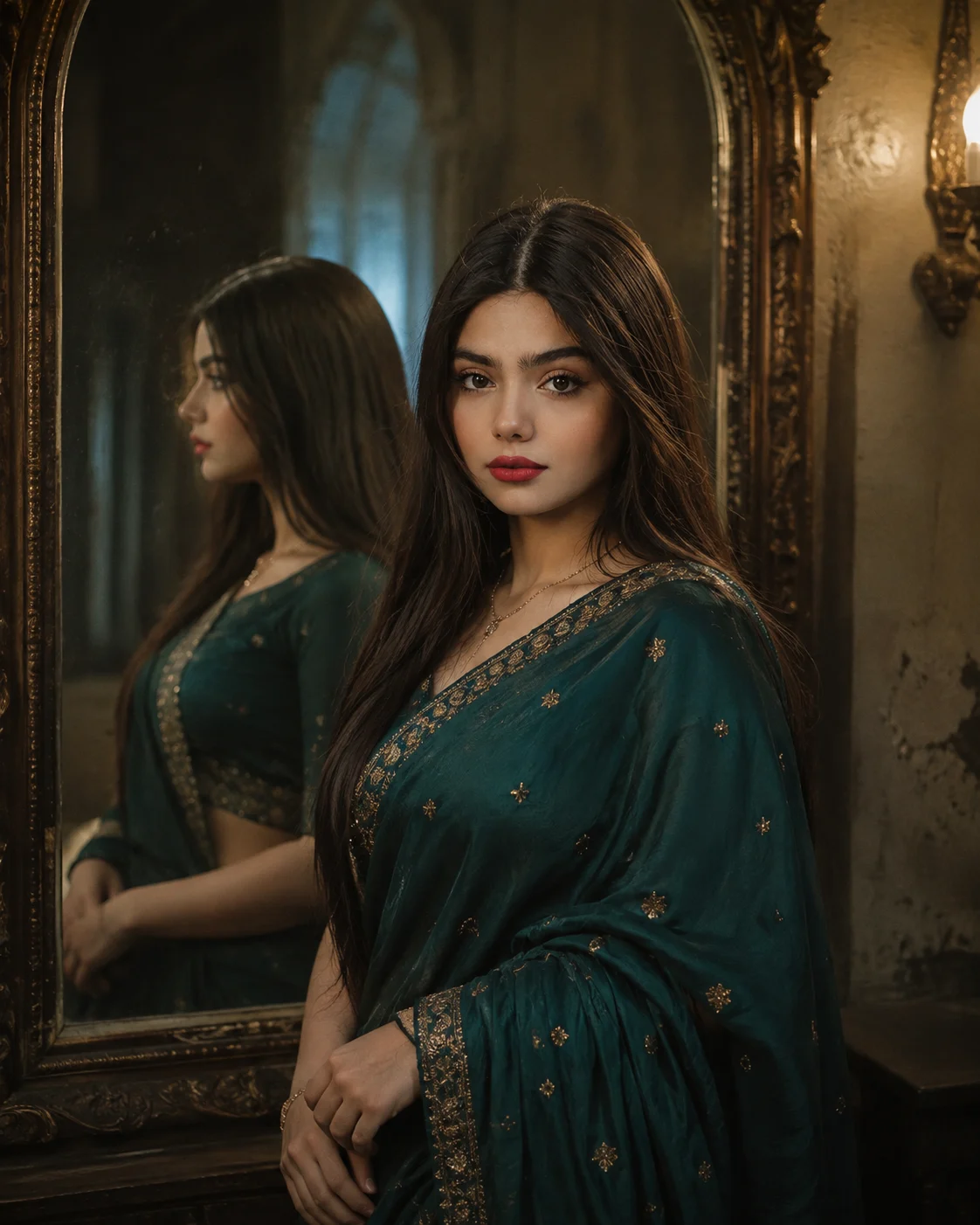
Mirror Reflection Fashion Portrait Prompt
Create a realistic vintage mirror portrait that preserves your face while adding an elegant teal saree, warm light, and cinematic detail.
Using the uploaded photo, create a photorealistic vertical 4:5 conceptual fashion portrait of the same person standing naturally before a large antique mirror inside a dim vintage room. KEEP - Preserve the uploaded person’s exact facial identity and recognizable face structure. Keep the forehead shape, eyebrow placement and shape, eye shape and natural eye colour, nose bridge and tip, lips, cheeks, cheekbones, jawline, chin, ears, facial width, and natural facial asymmetry. Keep the original skin tone, visible pores, fine texture, natural marks, under-eye detail, and authentic age. Keep the original hairline, hair density, natural hair texture and colour, including any visible facial hair if present. Keep the uploaded person’s natural body proportions, shoulder width, neck length, and realistic hand proportions. The mirror reflection must show the same identity and proportions without creating a second face. CHANGE - Dress the person in a [deep teal-green silk saree] with [subtle antique-gold embroidery] and a [matching fitted blouse]. Add only [delicate understated gold jewellery]. Change the setting to a [dim vintage room] containing a [large aged antique mirror]. Use a [relaxed three-quarter standing pose], with the body slightly angled while the face remains naturally visible. Add [warm tungsten interior light] mixed with [faint cool window light]. Use [muted cinematic colours] and restrained contrast. SCENE - Place the person approximately one step in front of the antique mirror, with the reflection clearly visible behind them. The room should contain aged plaster, muted architectural details, and soft shadowed surfaces rather than modern objects. Keep the mirror reflection realistic and aligned with the person’s position. Use shallow depth of field so distant room details become softly blurred while the face, saree texture, and mirror edge remain readable. LIGHT - Place the main warm tungsten source slightly above and to the front-left of the face, creating soft highlights on the forehead, nose bridge, cheek, and saree. Add weak window light from the opposite side for natural shadow fill. Keep the light direction consistent on both the person and reflection so the face never appears pasted into the room. CAMERA - Shoot at [85mm] with [f/1.8] at [chest height], using natural portrait-lens compression. Keep the camera parallel to the subject rather than using a dramatic low or high angle. Focus primarily on the nearest eye and allow the background and distant mirror details to fall gradually out of focus. GRADE - Apply a [muted warm-brown and teal cinematic grade] with moderate contrast, preserved skin tones, gentle highlight roll-off, and subtle fine film grain. Keep blacks slightly soft and avoid crushed shadows so the dark room still retains visible texture. OUTPUT - Generate a [vertical 4:5] image at [high resolution], with realistic skin, fabric, glass, mirror reflections, and fine hair detail. DO-NOT - Do not slim the face, whiten the skin, change eye colour, reshape facial features, smooth skin into plastic, invent jewellery or tattoos, duplicate facial features, distort hands, create extra fingers, alter the reflection’s identity, or add CGI-like textures.
Photo Guide
- Use a sharp photo with enough resolution to retain eye and hair detail.
- Face the camera or turn slightly so both eyes and the hairline stay visible.
- Soft front or side lighting helps reproduce the warm mirror-room shadows.
- Keep loose hair visible around the forehead to anchor the original identity.
- Avoid sunglasses or heavy shadows because they weaken the mirror reflection match.
- A visible three-quarter face works especially well with the antique mirror setup.
How to Build
- 1Use ChatGPT and choose image generation with the uploaded photo.
- 2Upload one clear source photo before pasting the full prompt.
- 3Keep the aspect ratio at 4:5 and request high resolution.
- 4Use 85mm-style portrait framing with f/1.8 depth of field.
- 5Check that the reflection matches the face, hands, pose, and clothing.
- 6If the first result is wrong, regenerate while naming the drifting feature.
Pro Tips
- Keep the hairline visible so the mirror does not alter facial proportions.
- Use a teal saree so the warm room creates controlled colour contrast.
- Keep jewellery minimal so attention stays on the face and reflection.
- Use soft side light so both faces share believable shadow direction.
- Keep the mirror edge visible so the reflection reads as physically grounded.
Share This Prompt
About the Author
Naziya
Creative AI writer at MFDA, sharing trendy photo-editing prompts and fresh ideas for beautiful, stylish AI images.